Narrative Awareness®
is an evidence-informed framework for personal growth, resilience, and well-being. It helps individuals become aware of the stories that shape their lives so they can respond more intentionally to everyday stress, life transitions, relationships, adversity, and trauma.
Narrative Awareness® is YOUR key to YOUR well-being.
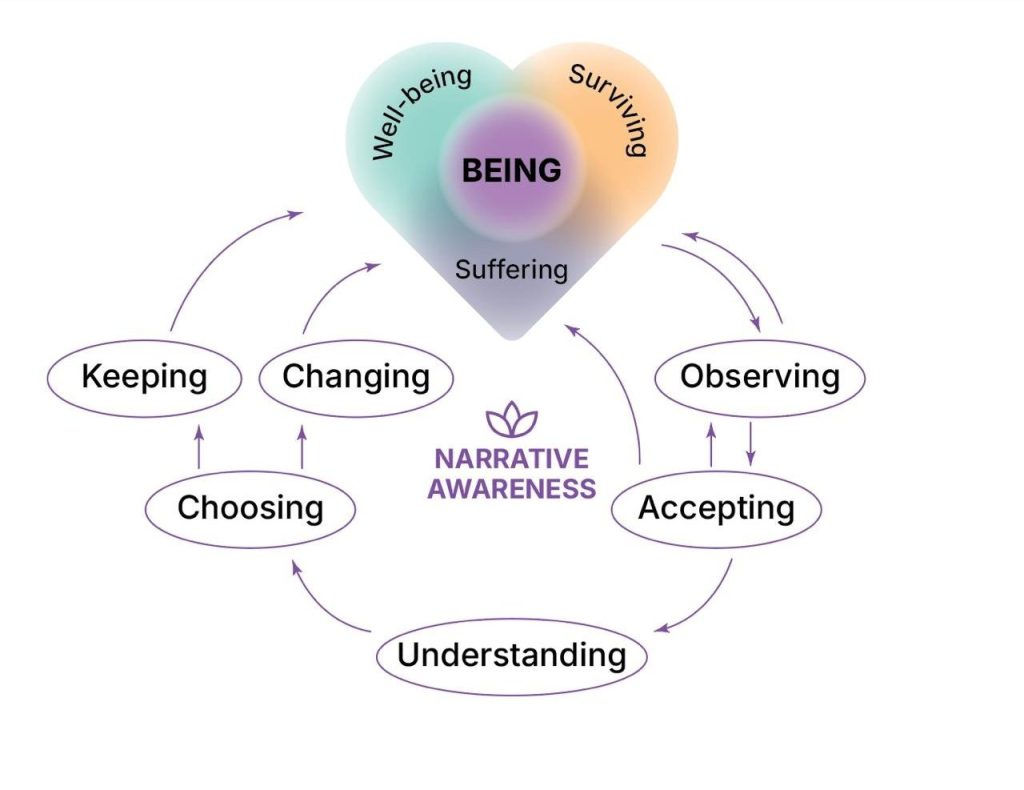
Narrative Awareness® is an evidence-informed framework for becoming aware of the stories we carry, understanding how they shape our experience, and recognizing our capacity to choose what we want to keep and what we may want to change.
We all carry narratives about ourselves, other people, our experiences, and the world around us. These narratives are shaped by our memories, relationships, culture, challenges, successes, losses, and hopes. They can influence how we think, how we feel, how we respond to difficult situations, and how we understand who we are.
Narrative Awareness invites us to notice these stories without immediately judging, rejecting, or trying to change them.
The framework integrates principles of mindfulness, storytelling, reflection, and intentional choice. It grew from research exploring how Ukrainian educators coped while living and working through prolonged trauma and was further developed for use with individuals, educators, caregivers, helping professionals, and communities.
The Six Stages of Narrative Awareness®
The framework moves through six interconnected stages:
Being → Observing → Accepting → Understanding → Choosing → Changing or Keeping
Being
We begin with our present experience. Sometimes simply being, surviving, breathing, and getting through the moment is enough.
Observing
We notice our thoughts, emotions, physical sensations, reactions, and the stories arising within us.
Accepting
We allow ourselves to recognize what is present without immediately labeling the experience as right or wrong.
Understanding
We become curious about our narratives: Where might this story come from? How does it influence my emotions, choices, relationships, and behavior? Is it helping me now?
Choosing
Awareness creates space for choice. We can consider how we want to relate to the story and what, if anything, we would like to do differently.
Changing or Keeping
Not every story needs to be changed. Some narratives support us and reflect what matters deeply to us. Others may no longer serve us. Narrative Awareness recognizes that the decision to reshape a narrative or consciously keep it belongs to the individual.
Awareness Before Change
Narrative Awareness is not about forcing ourselves to “think positively,” erasing difficult experiences, or replacing every painful story with a happier one.
It is about developing the capacity to notice, understand, and consciously relate to our own narratives.
Sometimes awareness leads to change.
Sometimes it leads to acceptance.
Sometimes it helps us recognize that a story is worth keeping.
And sometimes, especially during periods of trauma or overwhelming stress, simply Being is enough.
Everything begins with Being and, in some way, returns to Being.
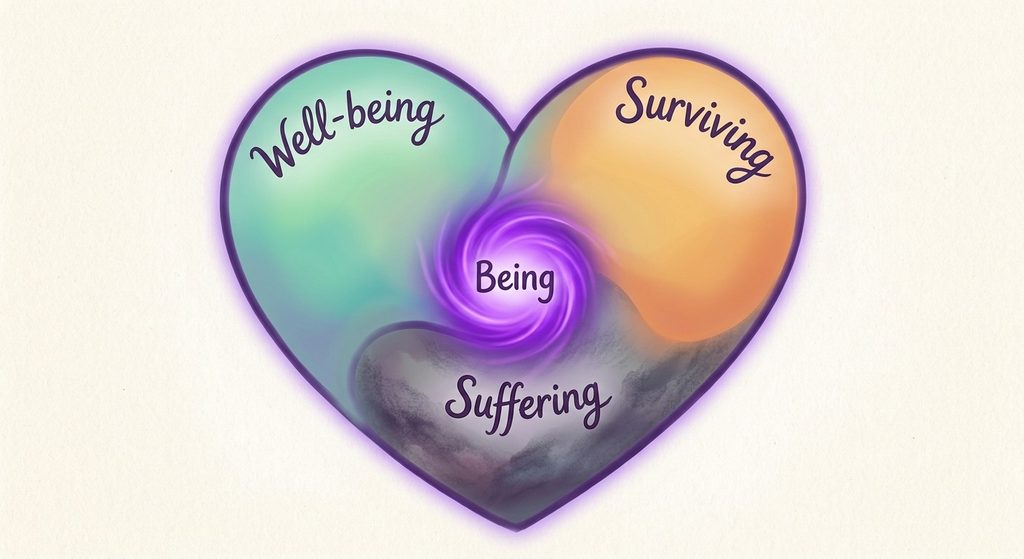
Being: Suffering, Surviving, and Well-Being
At the foundation of Narrative Awareness® is Being.
A person is, first and foremost, a human being. The simple statement “I am” remains true as long as we are alive. Yet what follows those two words can be very different from one moment, person, or period of life to another.
“I am at peace.”
“I am afraid.”
“I am suffering.”
“I am surviving.”
“I am well.”
All are expressions of Being.
Our state of Being is influenced by what is happening within and around us: our physical condition, emotions, thoughts, memories, relationships, environment, sense of safety, past experiences, and the narratives through which we understand those experiences.
Within the Narrative Awareness® framework, Being may be experienced through different states, including suffering, surviving, and well-being. These states are not fixed identities. A person may move among them throughout life, throughout a single day, or even within the same moment.
Being in Suffering
Suffering is part of the human experience. Physical and psychological pain occur throughout life through loss, illness, disappointment, trauma, separation, uncertainty, and many other experiences.
Pain and suffering, however, do not necessarily mean exactly the same thing. Pain may arise from circumstances we cannot control. Suffering describes the deeply personal experience that can develop in our relationship with that pain.
When suffering becomes prominent, our Being may become organized around what hurts. Our attention may be drawn toward loss, fear, grief, anger, helplessness, or the question, “Why is this happening?”
This does not make suffering wrong. It is one way of Being human.
Narrative Awareness does not ask a person who is suffering to immediately find meaning, think positively, or transform the experience. Sometimes the first and most compassionate response is simply to recognize:
I am suffering right now. This is what is present.
Awareness begins there.
Being in Survival
At other times, our primary task is simply to survive.
Survival is more than surviving extraordinary events such as war, violence, disaster, poverty, or trauma. At its most fundamental level, surviving means continuing to live and exist.
When a person experiences prolonged stress, danger, uncertainty, or exhaustion, Being may become centered around getting through the next moment, hour, or day.
In this state, questions about growth, happiness, productivity, or self-actualization may become secondary. The immediate question may simply be:
What do I need to make it through today?
Within Narrative Awareness®, survival is not viewed as a failure to achieve well-being. Sometimes surviving is enough.
Recognizing “I am surviving” is itself an act of awareness. It allows us to observe our current reality rather than demanding that we be somewhere else.
Being in Well-Being
At other times, Being may be experienced as well-being.
Well-being does not necessarily mean constant happiness or the absence of pain. A person may experience grief and still experience connection. A person may live with uncertainty and still experience meaning. Difficult circumstances and moments of peace can exist together.
Well-being can include feeling physically and psychologically safe, connected to others, loved, useful, capable, purposeful, and able to engage with life. It may also involve recognizing and using one’s strengths, experiencing meaning, and having opportunities to become more fully oneself.
For one person, well-being may sound like:
“I am peaceful.”
For another:
“I am connected.”
“I am loved.”
“I am useful.”
“I am becoming.”
Or simply:
“I am okay in this moment.”
We Move Between These States
Suffering, surviving, and well-being should not be understood as three permanent categories of people or as a simple linear progression.
They are states within the broader experience of Being.
A person may be surviving in one area of life while experiencing well-being in another. Someone may be grieving and suffering while simultaneously feeling deeply loved and connected. A person living through traumatic circumstances may experience moments of fear, moments of survival, and moments of joy within the same day.
We move among these experiences because Being is dynamic.
Suffering ↔ Surviving ↔ Well-Being
The purpose of Narrative Awareness® is not to insist that we remain in well-being or immediately move ourselves out of suffering. Rather, it begins by helping us become aware of where we are now.
What am I experiencing?
What am I feeling?
What story am I telling myself about this experience?
What do I need right now?
What is within my control, and what is not?
Is something asking to be changed, or do I simply need to allow myself to be?
This is why Being is both the beginning and the return point of Narrative Awareness®.
Before we can observe our narratives, we are Being. After observing, accepting, understanding, and choosing, we return to Being, perhaps with a different relationship to ourselves, our experiences, and our stories.
Sometimes Being means flourishing.
Sometimes Being means suffering.
Sometimes Being means surviving.
And sometimes the most meaningful thing we can recognize is simply:
I am.